

Milan Design Week 2026 has once again solidified its position as the world’s premier design event, transforming the Lombard capital into a sprawling laboratory of creativity, innovation, and cultural exchange. From April 20 to 26, the city buzzed with energy as designers, architects, artists, and design enthusiasts converged to explore the latest trends and groundbreaking ideas shaping the future of design. This year’s edition was particularly significant, featuring the 64th Salone del Mobile and the ever-expansive Fuorisalone program under the evocative theme “Be the Project” . The focus shifted from mere aesthetic outcomes to the dynamic, human-centered processes behind creation, emphasizing responsibility, transformation, and the integration of technology and nature .
As we reflect on the week’s highlights, several key themes emerged: the rise of multi-sensory and regenerative urban spaces, the celebration of emerging designers pushing material boundaries, the emphasis on slowing down and reconnecting with the tangible, and the seamless blending of traditional craftsmanship with cutting-edge technology. This article delves into the most compelling installations, exhibitions, and concepts that defined Milan Design Week 2026.
Thematic Overview: “Be the Project” and “A Matter of Salone”
The guiding principles of this year’s events encouraged a profound rethinking of design’s role in society. The Fuorisalone’s theme, “Be the Project,” invited participants to view design not as a final product but as a continuous, evolving process that fosters relationships between people, places, and communities . This was echoed by the Salone del Mobile’s theme, “A Matter of Salone,” which celebrated materiality as the origin of the creative process .
These themes were not just abstract concepts but were woven into the fabric of the events. The focus on “process” was visible in the increasing number of installations that prioritized visitor participation and sensory engagement over passive observation . Furthermore, a significant portion of the discourse was dedicated to regenerative urban living, where design is seen as a tool for creating spaces that act as living participants in our ecosystem . This is a direct response to global sustainability mandates and a growing desire for urban spaces that prioritize well-being and environmental harmony.
Multi-Sensory and Regenerative Urban Installations
This year, large-scale experiential installations were at the heart of Milan Design Week, using a sophisticated blend of sound, scent, light, artificial intelligence, and spatial design to communicate complex ideas .
AI, Sound, and Responsive Environments
One of the most talked-about installations was at the Fondazione Istituto dei Ciechi, where Dot Dot Dot and Geely created a responsive sound installation featuring a self-playing organ . The soundscape evolved in real-time based on the number of people in the room, while semi-transparent veils displayed AI-generated imagery informed by live data from the space. This project demonstrated how AI can be integrated into a responsive environment, creating a dialogue between human presence and technology . Similarly, Marco Nereo Rotelli’s AI-led installation at Cortile della Farmacia used environmental sensors and audience choices to generate projected poetic text, merging climate science, sound, and interaction .
Nature, Myth, and Urban Respite
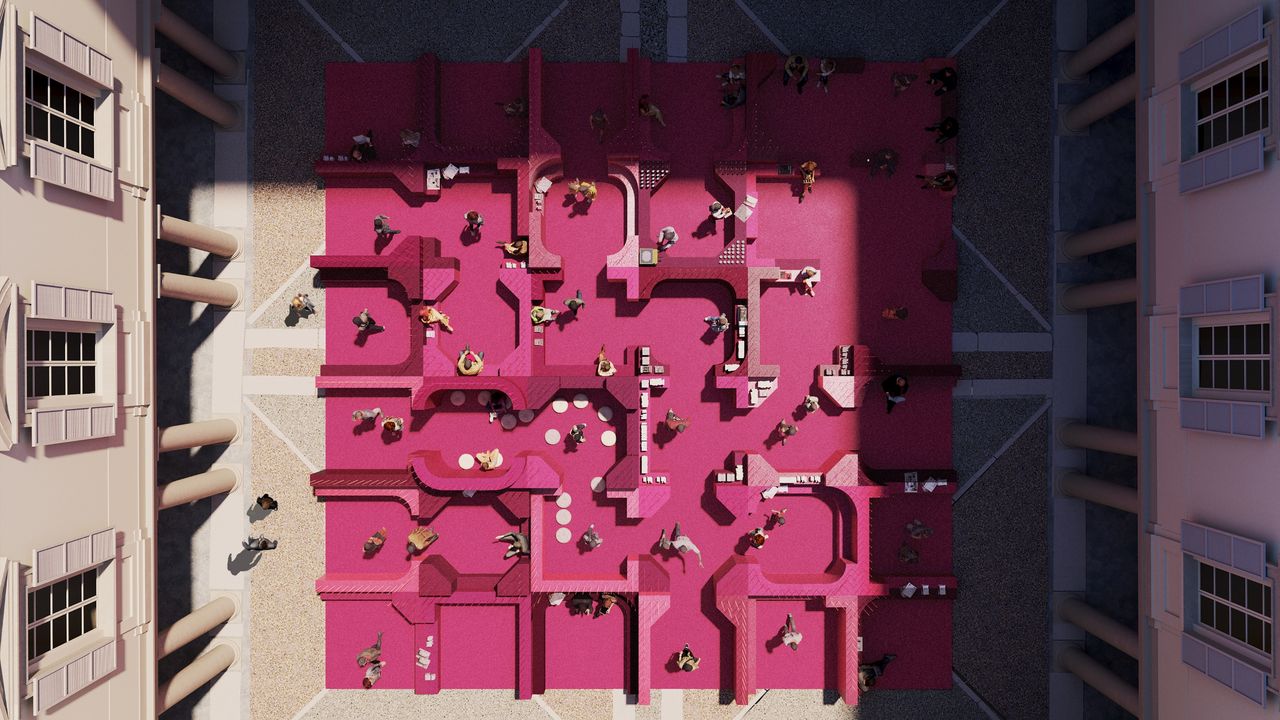
In stark contrast to the high-tech installations, many designers turned to nature and mythology to offer moments of calm and reflection. Annabel Karim Kassar’s Garden of the Hesperides at the Orto Botanico di Brera used large figurative works and an arched route to reinterpret the Greek myth of the nymphs guarding the golden apples of immortality . At Palazzo Litta, Lina Ghotmeh created a pink labyrinth titled Metamorphosis in Motion, which included spaces for reflection, conversation, and movement, supported by scent references to cypress, cedar, and olibanum . This installation, conceived as her first outdoor site-specific intervention in Italy, transformed the Baroque courtyard into an immersive architectural landscape .
These installations were not just visual spectacles but were designed to engage all the senses. Rick Tegelaar’s Oasis, developed with Pim Schrier, created a calming botanical room where visitors entered through illuminated woven plywood screens before encountering a new lighting collection, with scent and mechanical breeze adding further sensory detail .
Brand Installations with a Purpose
Commercial brands also used the platform for issue-led storytelling, integrating their products into immersive experiences. Grohe’s Aqua Sanctuary presented a wellbeing-focused exhibition across three rooms, combining water, light, and sculptural fittings to place its product launches within a sensory lifestyle context . Meanwhile, Continental’s The Sound of Premium, designed by WOA Studio, focused on urban sound pollution, using a cityscape of illuminated columns to demonstrate the sensory message behind its tyre technologies designed to reduce noise .
Salone del Mobile and Institutional Highlights
The Salone del Mobile at Rho Fiera remained the commercial heart of the week, featuring over 1,900 exhibitors and the return of the biennial EuroCucina/FTK and the International Bathroom Exhibition .
Major Retrospectives at Triennale Milano
The Triennale Milano, a cornerstone of the city’s cultural scene, hosted several must-see exhibitions. The most prominent was Andrea Branzi by Toyo Ito: Continuous Present . This major retrospective, developed in collaboration with the Fondation Cartier pour l’art contemporain, traced the career of the late Italian design master through over 400 works. Conceived by Pritzker Prize laureate Toyo Ito, the exhibition was organized as a non-linear, spatial sequence that emphasized the continuity between Branzi’s disciplines, scales, and temporal frameworks . It was a profound look at the roots of Italian Radical Design and Branzi’s anthropological approach to design .
Another significant exhibition at Triennale was The Eames Houses, which offered the first comprehensive overview of the residential architecture of Charles and Ray Eames, exploring their research into prefabrication and modular construction .
The ADI Design Museum and the Compasso d’Oro
The ADI Design Museum, home to the prestigious Compasso d’Oro collection, presented a packed program of temporary exhibitions . The 29th Compasso d’Oro 2026 exhibition showcased the finalists competing for the award, offering a preview of products and experiments that illustrate how design interprets the present . Other notable exhibitions included bit by bit – Haruka Misawa, the first Italian solo exhibition of the Japanese designer known for her poetic focus on imperceptible details, and Heritage Reimagined, SOBAN – Seoul Design Foundation, which reinterpreted the traditional Korean low table through contemporary craft and digital manufacturing .
The Rise of Emerging Designers and Material-Led Innovation
Milan Design Week continues to be a crucial launchpad for emerging talents, and 2026 was no exception. The SaloneSatellite, the ‘jewel in the crown’ of the Salone del Mobile, served as a vital incubator, presenting 700 international designers under 35 . This year’s theme, “Craftsmanship + Innovation,” was perfectly embodied by the winners:
A. Russo Betak (Danish Studio): Won first place for the Ark Collection, featuring lighting objects crafted from 3D-printed sheets of seashell biopolymer . The studio balances the precision of digital fabrication with the physical brilliance of hand-shaping, letting the unpredictable biomaterial unfold .
B. IOUS Studio (Netherlands-based): Secured second place with their project on 3D-printed ceramic tiles . This project used computational design to create a ceramic cladding system from 3D-printed clay, creating intricate, customizable forms with minimal waste .
C. JÜNGERKÜHN (Berlin-based): Received third place for its Soft Touch porcelain vases . The studio bridges industrial design and digital crafts, exploring robotics to create highly tactile, uniquely detailed porcelain pieces that showcase a lively, colorful appearance .
These winners demonstrate a clear trend in design: a move away from pure aesthetics towards a deeper engagement with materials, processes, and sustainability.
Other exciting emerging designers included Emilia Tombolesi, who presented her Calypso and Etna collections at the Brera Design District . Inspired by her Sicilian heritage, the Etna collection uses hammered aluminum molds to shape cast jesmonite, a versatile and eco-friendly material, capturing a moment of tension as if “frozen mid-eruption” . The Calypso series, a collection of cold-hammered sculptural objects, explores functional forms through expressive surfaces, playing with shapes drawn from collective visual memory .
District Highlights and Urban Expansions
The Fuorisalone extended across the city’s nine design districts, each with its own curated identity . The Brera Design District, with its 217 permanent showrooms and over 190 temporary exhibitors, hosted over 300 initiatives . The district was a hub of activity, with installations like the immersive Sounds of Design providing a platform for emerging talents like Emilia Tombolesi to gain international visibility .
Alcova’s Expansion
One of the most anticipated independent platforms was Alcova, now in its eleventh edition . Curated by Valentina Ciuffi and Joseph Grima, Alcova continued to push boundaries by opening previously inaccessible spaces. In 2026, it occupied two significant sites representing Milan’s urban identity: the former Baggio Military Hospital in the Primaticcio district and the private residence Villa Pestarini, designed by Rationalist master Franco Albini . With over 120 international exhibitors, Alcova has cemented its role as a key venue for discovery and experimentation .
Outdoor Living and Regenerative Spaces
Outdoor design took center stage, with a focus on products that dissolve the boundary between interior and exterior . The La fabbrica dell’ombra installation by Fim Umbrellas, designed by 967arch, celebrated the craftsmanship of creating shade, a critical element of outdoor comfort . Other trends in outdoor design included the use of sustainable materials, such as the Raytent project by Giovanardi, which transformed recycled acrylic fabric scraps into new yarns and panels . Bioclimatic pergolas like Gibus’ Velvet were featured in installations exploring “outdoor living as a continuous environment” .
The focus on regenerative urban spaces was also evident in the Isola district, where the Magritte project demonstrated the use of regenerated nylon in 3D printing, showing how waste can be repurposed into structural design elements . In the Tortona district, the conversion of industrial complexes like Opificio 31 into creative hubs for installations like Soundsorial Design (a collaboration between Devialet and IQOS) highlighted the move towards social inclusivity and urban regeneration .
Blending Technology and Tradition
The dialogue between technological innovation and traditional craftsmanship was a defining feature of the 2026 edition. This was most apparent in the SaloneSatellite winners, where 3D printing and robotics were used to create products from biomaterials, clay, and porcelain . Beyond the fairgrounds, the Renaissance of the Real installation by Snøhetta and Annabelle Schneider at the Fondazione Luigi Rovati used the modular logic of the USM Haller system to support a responsive textile membrane, creating a “soft, enclosed spatial environment” that encouraged visitors to unplug from the digital world and engage with physical sensations .
Conclusion
Milan Design Week 2026 was a resounding success, showcasing a design world that is increasingly complex, conscious, and collaborative. The overwhelming narrative was one of “process over product,” where the journey of creation and its impact on people and the planet is as important as the final object. From the multi-sensory installations that invited us to pause and reflect, to the emerging designers redefining materiality, and the major retrospectives honoring design history, the week offered a glimpse into a future where design is a powerful tool for regeneration, connection, and meaningful change. The event firmly established that while Milan remains the global stage, the energy and innovation are increasingly found on the margins, where young, independent voices are rewriting the rules and leading the industry forward.